
Due Diligence or Due Disaster? Real-World Lessons from Restaurant Expansion
In restaurant development, every action has a reaction, and few decisions carry more weight than what happens before you sign a lease. Early due diligence isn’t just a step in the process; it’s a strategic advantage that can prevent months of lost rent, eliminate six-figure surprises, and safeguard the design and operational vision of a brand.
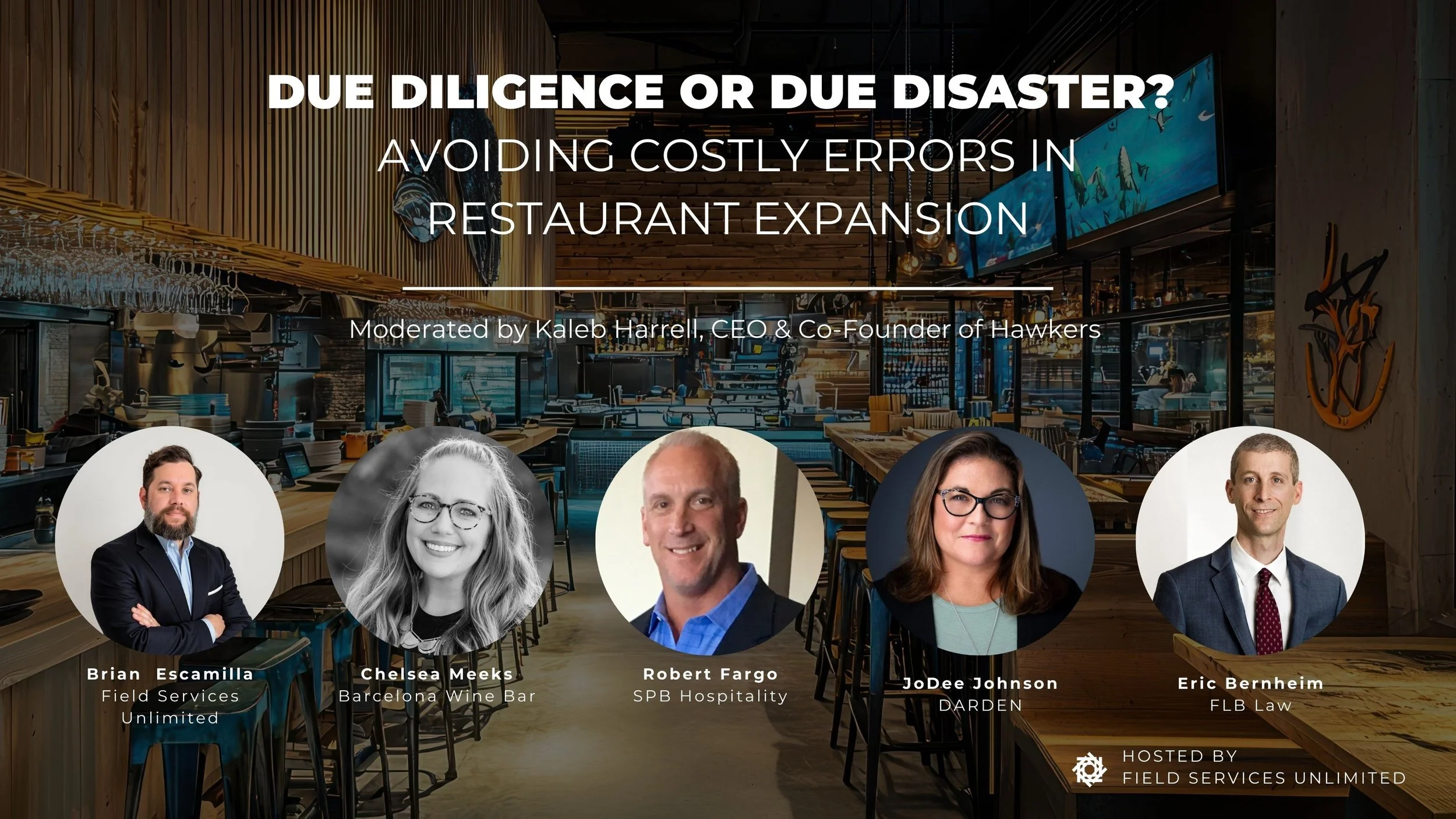
During the recent LinkedIn Live webinar, Due Diligence or Due Disaster? Avoiding Costly Errors in Restaurant Expansion, industry leaders across development, legal, architecture, and design came together to share the realities of restaurant expansion. Across every brand, market, and prototype type, one message was clear:
Proactive, structured due diligence saves time, money, and headaches. And…it eliminates a lot of sleepless nights!
The unique webinar was moderated by Kaleb Harrell, CEO and Co-Founder of Hawkers Asian Street Food. With previous experience as the co-founder of a marketing agency serving brands like Disney, UPS, and Chevrolet, recognition as a CEO of the Year along with being an Ernst & Young Entrepreneur of the Year finalist, Harrell’s perspective and insights emphasized that early, thorough due diligence is what keeps restaurant projects from spiraling and help to create and maintain the “soul of the space.”
He noted that rushing through development is like “trying to change the oil in the car while you’re going around the track.” Despite the inevitable tension between creative vision and practical budgeting, he was clear in his analysis:
Most delays and overruns trace back to oversights that could have been caught early on. Read on for additional insights from our panelists: Eric Bernheim, Managing Partner at FLB Law; Brian Escamlilla, AIA, NCARB, Senior Vice President of Operations for Field Services Unlimited; Robert Fargo, Senior Vice President of Development at SPB Hospitality; JoDee L Johnson, Director of Design at Darden; and Chelsea Meeks, VP of Development & Design at Barcelona Wine Bar.
Why Early Due Diligence Matters
Early due diligence delivers clarity before commitments are made, especially before the Letter of Intent (LOI) stage. It uncovers the zoning limits, permitting path, utility capacity, and hidden conditions that directly influence cost, timing, and feasibility of both new builds and rebuilds.
As panelist Brian Escamilla, Senior Vice President of Operations for Field Services Unlimited, noted, “The last thing you want to be is reactive. When you're reacting, it's usually late in the game and ends up causing weeks of delays and costing hundreds of thousands of dollars.”
The session emphasized the hidden ROI of due diligence:
· Reduces redesign cycles
· Avoids unexpected capital expenditure outlays
· Accelerates permitting
· Supports accurate scheduling and budgeting
· Arms legal teams with facts rather than assumptions
Whether you’re developing your first location or managing a national rollout, this front-end work preserves momentum and minimizes costly surprises.
Revealing Risks Early: The Role of Pre-LOI Surveys
Pre-LOI surveys were a major focus of the conversation. Brian described these “small scope” evaluations as sanity checks that confirm whether a site can even support the concept operationally, mechanically, and structurally.
Data capture from site surveys often uncover potential risks such as:
· Insufficient electrical or mechanical capacity
· Structural limitations
· ADA and code issues
· Compromised grease systems
· Conflicting utility routes
· Multi-tenant constraints or neighboring-tenant impacts
These findings feed directly into stronger, clearer lease negotiations. As Brian put it, due diligence creates “site truth,” that is, facts that equip teams to negotiate from a position of strength.
And today’s technology elevates this process even further. 2D/3D scanners, digital twins, and Matterport models give architects and engineers complete visibility into what lies behind walls and above ceilings, reducing field surprises during construction.
Legal and Leasing Safeguards: Turning Insights into Protection
Attorney Eric Bernheim, Managing Partner at FLB Law, emphasized that due diligence doesn’t stop at discovery. It must translate into clear, enforceable lease terms. The last thing you want is a dispute with the landlord, preventing scheduled openings and months of dead rent.
His guidance included:
· Strong landlord work letters outlining exact delivery conditions
· Inspection rights before rent or TI timelines begin
· Clear responsibilities for structural, roof, and shared system repairs
· Hazmat clauses protecting tenants from pre-existing contamination
· Surrender terms that avoid costly end-of-lease demo requirements
· Allowances that reflect real-world buildout conditions, not assumptions
Eric warned that one of the most overlooked issues occurs when a restaurant’s Certificate of Occupancy (CO) is held up because another tenant or the landlord has not completed required site improvements. Early legal conditioning and landlord delay clauses are key to protecting both schedules and budgets.
Design Feasibility: Protecting Concept Integrity
Barcelona Wine Bar’s VP of Development & Design Chelsea Meeks explained how due diligence is not just about cost, but rather it's about preserving the brand experience.
Barcelona frequently pursues older, character-rich spaces, including historic structures, former dry cleaners, and second-generation retail. Chelsea shared: “The earlier you know what you’re dealing with, the easier it is. It’s not about reacting later. It’s about planning smart upfront.”
Key design-related due diligence items include:
· Grease trap and venting feasibility
· Historic approvals and sequencing requirements
· Structural load capacity
· Limitations impacting kitchen or bar design
· Guest-facing vs. non-visible cost trade-offs
Sometimes the deciding factor isn’t the condition of the building. It’s the cost of overcoming it. Barcelona uses due diligence to evaluate whether a high-character site is “worth” the additional money, permitting complexity, or engineering modifications required.
Scaling Smart Across Multiple Markets
Bob Fargo, SPB Hospitality’s Senior Vice President of Development, explained how early due diligence supports consistent decision-making across a diverse brand portfolio.
With multiple concepts, different prototypes, and varying state regulations, SPB relies on due diligence to avoid repeating costly mistakes across markets. From liquor licensing and drive-through restrictions to structural issues and utility capacity, early intelligence protects both project pipelines and corporate budgets.
Bob summed it up well:
“Due diligence answers three questions:
1. Can I do it?
2. How long will it take?
3. And how much will it cost?”
Prototype Fit and Long-Term Reliability
For Darden’s Director of Design JoDee Johnson due diligence ensures prototype integrity and operational reliability for decades to come. Because Darden operates at national scale with strict standards, even small deviations like signage restrictions, elevation changes, HVAC capacity, or dumpster placement can disrupt long-term operational efficiency or brand consistency.
Her team evaluates:
· Site visibility and traffic patterns
· Code-driven design impacts
· Long-term maintenance considerations
· Mechanical, electrical, and plumbing (MEP) infrastructure reliability
· Structural constraints affecting kitchen and dining layouts
Many of these insights must be known before design begins, not during construction, or worse, after opening.
Common Oversights That Lead to “Dead Rent”
Several panelists shared real-world examples from their experiences of what could’ve been preventable delays. These serve as lessons learned for new buildouts:
· Hidden structural damage discovered after lease execution
· Transformer shortages in fast-growth areas (Arizona, Utah)
· Water meter delays (e.g., Jacksonville, FL)
· Permitting tied to incomplete landlord or co-tenant work
· Venting restrictions in multistory or urban buildings
· CO₂ storage permitting in highly regulated states (e.g. Colorado)
These issues may sound unavoidable, but most could have been identified during robust due diligence.
The Action–Reaction Advantage
Across legal, design, development, operations, and permitting, these lessons emerged:
· Early intelligence leads to smoother openings, which result in long-term savings.
· Predictable timelines preserve your opening date.
· Clear site data protects your budget.
· Cross-functional collaboration guards your brand.
As Chelsea noted, “The hardest sites often become the best ones as long as you know what you’re getting into.”
The Bottom Line
Anything is possible in restaurant development but not everything is feasible, and almost nothing is free. Strategic due diligence helps teams:
· Avoid surprises
· Strengthen negotiations
· Preserve design vision
· Accelerate timelines
· Reduce long-term cost exposure
In today’s competitive restaurant landscape, early and thorough due diligence isn’t just a best practice, it’s a strategic imperative. The brands that consistently open on time, on budget, and without surprises are the ones that invest in understanding a site long before the ink hits the lease.
When you uncover the risks, constraints, and true costs early, you gain control of the timeline, protect your capital, and negotiate from a position of strength. Skipping this step doesn’t save time, but rather it invites delays, redesigns, and costly missteps that could have been avoided.
In short, due diligence is the difference between a smooth opening and a preventable disaster. It remains the single most powerful tool owners and operators have to safeguard both their vision and their bottom line.
Whether you're building your first location or expanding across the country, early and thorough due diligence is the smartest investment you can make to ensure your restaurant has the best chance for long-term success. For more insights, be sure to watch the webinar.
About The Panelists
Eric Bernheim, Managing Partner at FLB Law
Eric D. Bernheim is Managing Partner at FLB Law, where he advises national hospitality brands, local businesses, and municipalities on real estate and business-related matters. Recognized as one of Fairfield County’s leading real estate attorneys, Eric represents developers, landlords, tenants, and lenders in acquisitions, leases, financing, and land use projects.
Known for his practical negotiating style and creative problem-solving, he has led major initiatives including The SoNo Collection redevelopment and national expansions for bartaco, Barcelona Wine Bar, Hawkers, and Sixty Vines. He founded the Real Estate Outlook, a yearly roundtable discussion that offers industry insights on commercial real estate projects regionally. He’s earned accolades including Chambers USA, Rating by Martindale-Hubbell, Best Lawyers in America®, and Connecticut Super Lawyers.
Brian Escamlilla, AIA, NCARB, Senior Vice President of Operations for Field Services Unlimited
Brian Escamilla, AIA, NCARB, brings more than 20 years of experience in architectural project delivery, business operations, and team leadership to his role as Senior Vice President of Operations for Field Services Unlimited. With a background in managing project financials, creating and implementing firmwide SOPs, and mentoring project managers,
Brian is dedicated to driving operational excellence. He is focused on leveraging data-driven processes and hands-on coaching to empower project managers, elevate team performance, and ensure consistent, high-quality outcomes for FSU’s clients.
Robert Fargo, Senior Vice President of Development at SPB Hospitality
Robert J. Fargo is Senior Vice President of Development at SPB Hospitality, where he oversees development strategy and execution for brands including J. Alexander’s, Stoney River, Logan’s Roadhouse, Krystal, Amada, and Village Whiskey. With more than 25 years of experience leading real estate, design, construction, and facilities teams, Robert is recognized for delivering scalable growth and measurable cost savings. He led prototype redesigns saving over $200K per project, instituted an owner-provided procurement program saving $2 million, and launched a national 12-week new restaurant opening process that improved speed-to-market and quality control.
Before joining SPB, Robert held leadership roles at Sky Zone, Ideal Image, and PDQ Restaurants, where he built development teams from the ground up, reduced CapEx spend, and oversaw the opening of more than 100 locations nationwide.
JoDee L Johnson, Director of Design at Darden
Having 30 + years in the design, construction and facility industry, I have seen or been involved with almost any set of circumstances in the development process. This has allowed me to do extensive traveling and I enjoy the speed and the long days that accompany travel. I mostly enjoy the personal interaction with the people who have the “boots on the ground” for each individual project.
I feel that having a personal commitment and honest approach to each project and owner, is needed to create a smooth and clear process. Being brought up in a construction household, being part of a team, working hard and getting the project completed, on time and right was forever embedded into my DNA. Although a trained architect, this practical foundation has allowed my career to always be based in reality and have a solution driven, no nonsense approach.
Chelsea Meeks, VP of Development & Design at Barcelona Wine Bar
As VP of Development & Design, Chelsea Meeks leads the design, construction, and facilities teams that bring Barcelona Wine Bar’s spaces to life. She began her career in architecture firms before moving to the owner’s side, where she discovered her love for restaurants and the impact well-designed spaces have on operations and guest experience. Since joining Barcelona in 2022, Chelsea has overseen several new openings—along with the first Corsica Wine Bar—supporting the brand’s intentional expansion.
Chelsea pairs design vision with a clear understanding of how restaurants truly function, creating environments that allow teams to stay focused on delivering exceptional hospitality. She brings clarity, collaboration, and a high design standard to every project she leads.