
Rethinking Retail Footprints: Shifting from Square Footage to Strategic Space
For decades, the retail playbook was straightforward: expand your footprint and increase your inventory, then sales would follow. Bigger stores meant bigger opportunities or so the thinking went. But today’s retail leaders are rewriting that narrative.
In a rapidly evolving landscape shaped by e-commerce, shifting consumer expectations, and rising operational costs, “more” is no longer synonymous with “better.”
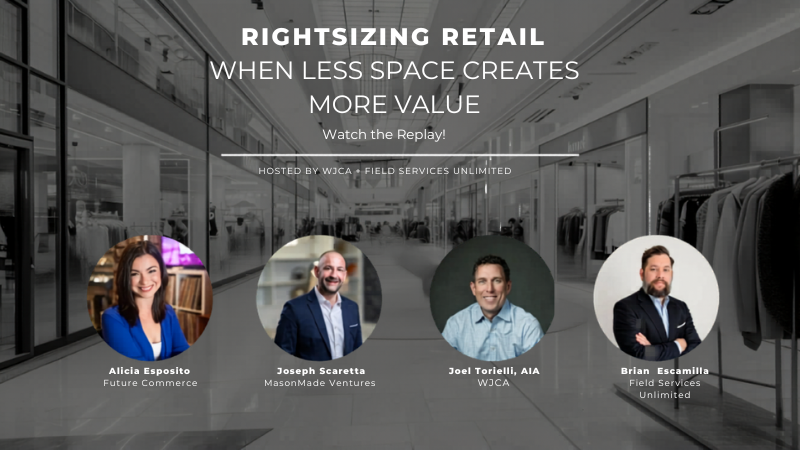
In a recent webinar moderated by Alicia Esposito of Future Commerce, panelists Brian Escamilla of Field Services Unlimited, Joel Torielli of WJCA, and Joseph Scaretta, of MasonMade Ventures unpacked how retailers are rethinking store size, design, and strategy.
Alicia framed the discussion by noting that “growth isn’t always synonymous with larger footprints,” highlighting how today’s retailers are shifting away from expansion for expansion’s sake and toward more intentional, high-performing spaces.
The consensus was clear: success is no longer about scale. It’s about precision, purpose, and performance.
From Bigger Stores to Better-Performing Stores
Retailers are no longer asking, “How big should our stores be?” but rather, “How effective can our stores become?”
Brian emphasized that store size decisions today are deeply rooted in performance metrics rather than legacy assumptions. “We’re seeing brands move away from historical benchmarks and instead ask what the data is telling them about how customers actually shop,” he explained. “In many cases, that leads to smaller, more focused environments.”
This shift reflects a broader understanding that physical stores must do more than simply hold inventory. They must guide customer journeys, support omnichannel fulfillment, and deliver memorable experiences; all within a carefully curated space.
Joel explained the shift clearly: “For years, square footage was treated as a key metric for success… more space implied more sales, more presence, more brand strength.”
Today, that mindset has been replaced with a sharper focus on efficiency. As Joel noted, “Productivity per square foot is now the more important metric, not total square footage.”
With higher rents, labor costs, and construction expenses, every square foot now carries a financial burden. Retailers are responding by building stores that are not just smaller, but more productive and are designed to perform with purpose, not just exist.
Alicia noted that post-COVID retail has accelerated collaboration between landlords, retailers, and developers, creating more dynamic spaces and stronger partnerships. She described it as “people on all sides being more collaborative, data driven and flexible,” helping malls and shopping centers evolve into true destination experiences.
This evolution reflects a broader industry realization: more space doesn’t automatically create more value. In many cases, it creates inefficiencies that dilute both profitability and customer experience.
Data, Intentionality, and the Rise of Smarter Store Design
At the core of rightsizing retail is a deeper reliance on data and a stronger sense of intentionality. Retailers are no longer making expansion decisions based on intuition or opportunity alone. They are using detailed insights to guide every move.
Joe emphasized the range of factors that now shape store decisions, noting the importance of “demographic data, customer foot traffic, the competitive landscape, and merchandise allocation.”
But beyond traditional analytics, retailers are also studying how customers actually move through and interact with stores. Joe added that “customer flow and customer journey also play very strongly into optimizing the store footprint today.”
Rather than chasing maximum reach, many brands are building “smaller footprints that are hyper-local,” Alicia noted, focusing on attracting the right customers and creating deeper engagement rather than simply increasing square footage.
Joel highlighted how advanced data tools are transforming footprint strategy. “It’s not just about sales per square foot anymore,” he said. “We’re analyzing how customers move through the space, what they engage with, and where friction occurs. That insight allows us to design stores that are both efficient and intuitive.”
This shift has led to a more intentional approach to retail expansion. Joel reflected on how different things were in the past, describing it as “a land grab… just snatching up real estate” without always considering long-term performance.
Now, retailers are far more disciplined. They are carefully selecting locations, tailoring store formats to specific markets, and aligning each space with clear business objectives. The result is a more strategic, data-informed retail landscape where every decision is deliberate.
Designing for Purpose: Every Square Foot Has a Job
A central theme of the discussion was that rightsizing is not simply about reducing space. It’s about redefining how that space is used. Brian captured this idea succinctly: “Right sizing isn’t about making stores smaller necessarily. It’s about assigning purpose to each square foot.”
He went on to explain how this represents a fundamental shift in thinking: “Retailers have to optimize every square foot as opposed to the old model of maximizing square footage.”
In practice, this means stores are becoming more multifunctional. A single location might serve as a showroom, or a fulfillment hub, or a brand experience center. However, with this efficiency comes less flexibility. Brian noted that smaller formats are “less forgiving,” meaning that mistakes or late-stage changes can have widespread operational consequences.
Because of this, early decision-making and strong upfront planning have become critical. What used to be adjustable during construction must now be resolved at the start of the process.
Where Rightsizing Saves and Where It Doesn’t
While reducing square footage can lead to cost savings, the panelists were quick to caution that rightsizing is not simply a cost-cutting exercise. While savings often come from reduced rent, lower utility costs, and streamlined staffing models, those gains can be offset by the need for enhanced digital integration, upgraded displays, and more frequent inventory replenishment.
“Smaller stores don’t automatically mean cheaper stores,” Joe noted. “In fact, you may invest more in design, technology, and fixtures to make that smaller space work harder.” The key, according to the panel, is intentionality. Cutting space without enhancing the experience can ultimately hurt performance rather than improve it.
Joe explained, “We’re seeing brands rethink their investment timelines. Instead of large, infrequent remodels, there’s a shift toward more agile, phased updates that allow stores to evolve over time.”
This approach not only reduces risk but also enables retailers to test new concepts, gather feedback, and refine their strategies before scaling.
Customer Experience and Operational Reality in Smaller Formats
One of the biggest concerns with smaller stores is whether they can still deliver a compelling customer experience. According to the panel, the answer lies in how the space is designed, not how large it is.
Joel explained that customers don’t evaluate stores based on size: “Customers don’t experience square footage… they experience friction or the lack of friction.”
This insight reframes the entire design approach. Instead of focusing on how much space is available, retailers must focus on how effectively that space works. Clear navigation, intuitive layouts, and efficient interactions become the defining elements of a successful store.
Alicia emphasized that physical retail still plays a powerful role beyond transactions, explaining that “commerce is inherently a cultural experience and a cultural exchange.” This reflects why many brands are designing stores less as inventory hubs and more as immersive environments where customers connect with products, stories, and service.
Joe also highlighted the balance retailers must strike between cost savings and investment: “There are definitely trade-offs… smaller space equals a more cost-effective footprint… but you may need to leverage more technology.”
Joel added, “Smaller footprints force discipline. You have to be very intentional about what you show and how you show it. That often leads to a more compelling and cohesive experience.”
Operational Challenges of Smaller Stores
While the benefits of rightsizing are compelling, the transition is not without its challenges. Shrinking a store footprint can introduce operational complexities, particularly in areas like inventory management, staffing, and fulfillment. With less back-of-house space, retailers must rely more heavily on efficient supply chains and real-time inventory visibility.
“Execution becomes critical,” Joe noted. “When you have less room (literally) for error, you need systems and processes that are incredibly tight.”
Additionally, employees must adapt to new roles and workflows. In smaller stores, associates often take on multiple responsibilities, from customer service to order fulfillment, requiring additional training and support.
As retailers reduce square footage, Alicia reminded the panel that efficiency cannot come at the expense of brand trust: “You don’t want a smaller footprint to put the brand promise at risk.” Rightsizing succeeds only when customer experience remains central.
The Future of Retail: Stores Built Around Purpose, Not Size
Looking ahead, the panel agreed that the conversation will continue to evolve beyond square footage altogether. The future of retail will not be defined by how big or small stores are, but by the roles they play.
Brian framed this shift clearly: “It’s not how big or how small the store is, but what job does the store perform.” Joel reinforced the same idea, adding that “it’s not going to matter how much square footage you have, it’s really going to matter how well you use the space.”
This clarity also strengthens brand storytelling. With less space to work with, every element from layout to lighting to product placement must align with the brand’s identity and values.
Together, these insights point to a future where retailers’ portfolio includes a mix of store formats, each designed with a specific purpose, whether that’s driving transactions, building brand awareness, or supporting fulfillment.
Rightsizing as a Fundamental Shift
If there is one question retailers should ask as they rethink their footprint strategy, it’s this: What is the core purpose of this store? As Brian put it, “What job does this location perform in the ecosystem?” Answering that question unlocks everything else, from size and layout to technology and staffing.
Rightsizing retail isn’t about doing less. It’s about doing exactly what’s needed with clarity, intention, and precision.
As the panelists made clear, rightsizing is not a temporary trend but a fundamental shift in how retailers think about physical space. By embracing data, prioritizing experience, and designing with intention, brands are discovering that less space can indeed deliver more value. More clarity. More engagement. And ultimately, more sustainable growth.
Brian summed it up clearly: “Rightsizing isn’t about doing less. It’s about doing better with what you have.” In a world where efficiency and experience must coexist, that mindset may be the most valuable asset of all.
Moderator
Alicia Esposito is Director of Content and Media Strategy for Future Commerce, a culture magazine for the commerce industry. Future Commerce leads the industry with compelling analysis, incisive commentary, cultural insights, and immersive media. Alicia has spent the last 15 years in the retail industry, working as a reporter, editor, content strategist, and media producer.
Panelists
Brian Escamilla, AIA, NCARB brings more than 20 years of experience in architectural project delivery, business operations, and team leadership to his role as Senior Vice President of Operations for Field Services Unlimited. With a background in managing project financials, creating and implementing firmwide SOPs, and mentoring project managers, Brian is dedicated to driving operational excellence. He is focused on leveraging data-driven processes and hands-on coaching to empower project managers, elevate team performance, and ensure consistent, high-quality outcomes for FSU’s clients.
Joel Torielli, AIA is Managing Partner at WJCA, a national architecture, planning, and project management firm delivering complex retail, hospitality, and commercial projects across the United States. He brings deep expertise in zoning, land use, and entitlement strategy, helping clients navigate approvals and regulatory constraints early in the development process. Joel works closely with developers, brands, and municipalities to guide projects from site selection through construction and occupancy, aligning design vision with execution to minimize risk and delays. Known for his pragmatic approach and client-focused mindset, he emphasizes thoughtful design, disciplined project management, and collaborative execution across every phase of a project.
Joseph Scaretta is Co-CEO and Co-Founder of MasonMade Ventures, an operational holding company investing in businesses that provide visibility and specialty trade services to support critical infrastructure. A serial entrepreneur and investor, Joe has built and scaled two facility management companies from startup to more than $50 million in revenue, each culminating in a successful private equity exit. He is known for identifying industry gaps, developing specialized service offerings, and building people-centered organizations that support long-term growth. Joe is a recognized voice on entrepreneurship, retail trends, and social impact, with appearances on Bloomberg Television and CNBC, and features in national business publications.
You can watch the full webinar here.